Many companies reach a point where their current logistics no longer fit their business model. The reason, almost always, is the same: they are using a traditional logistics structure to manage a business that already operates, partly or entirely, as an e-commerce business.
They are not the same thing. And confusing them costs money, orders, and customers.
Traditional logistics refers to the management of the flow of goods and services from the point of origin to the point of consumption. It typically involves activities such as warehousing, transportation, inventory management, and order fulfilment. This model is generally suited for businesses that have a well-defined and stable supply chain, with predictable demand and production volumes. Companies that operate in industries with relatively low product variety and complexity, or those that focus on mass production and distribution, might find traditional logistics to be an effective approach. Examples include manufacturers of basic consumer goods, food and beverage companies with standard product lines, and retailers with a consistent inventory turnover.
Traditional logistics —also called B2B logistics or integral distribution— is designed to move goods between companies: from manufacturer to distributor, from distributor to retailer, from importer to central warehouse.
- Handling of pallets and full boxes, in loose units
- Flexible delivery times: 24-72 hours or more, as agreed
- Predictable volumeAdvance planned orders, no unforeseen spikes
- Business recipientsWarehouses, shops, distribution centres
- Billing per pallet, m² or full load
A comprehensive logistics and distribution warehouse works very well for a company moving 500 pallets a month with fixed destinations and scheduled orders. When that same business starts selling online and the orders become 3,000 individual packages a month with different destinations each day, the model breaks down.
What is e-commerce logistics and how does it differ?
E-commerce logistics – or fulfilment – is the operation designed to manage the complete online order cycle: inventory reception, storage, individual preparation, shipping to the end consumer, and returns management.
- Orders of 1 to 5 units aimed at individual consumers
- Delivery within 24-48 hours as a minimum expected standard
- Highly variable volumeA Black Friday can multiply normal volume by 10
- High return ratebetween 10% and 30% in fashion or electronics
- Customer experience as an KPIThe packaging and shipping communication are part of the product
Comparison: Traditional Logistics vs. E-commerce Logistics
These are the differences that have the most impact on day-to-day operations:
Movement and destination unit
Traditional logistics moves entire pallets or boxes to businesses. E-commerce logistics moves individual orders of 1 to 5 units directly to the end consumer. These are two flows that require different processes, equipment and technology.
Deadlines and predictability
In B2B, lead times are flexible and orders are predictable. In e-commerce, the customer expects to receive their order within 24-48 hours, and volumes can increase tenfold during Black Friday with no prior warning.
Returns management
In traditional logistics, returns are infrequent and planned. In e-commerce, they are continuous, represent between 10% and 30% of the volume, and the inspection and re-stocking process must be executed in less than 48 hours.
Technology integration
Traditional logistics is integrated via ERP or EDI. E-commerce logistics requires real-time API integration with Shopify, WooCommerce, PrestaShop, and Amazon. Without that synchronization, the store's inventory does not reflect the reality of the warehouse; reorders are calculated blindly, and the data is fed into the ERP system. Bullwhip Effect.
Metrics that matter
In traditional logistics, metrics are cost per pallet and m² occupancy. In e-commerce, they are time to ship, order accuracy rate (>99.5%), and return processing time.
When you need a comprehensive logistics operator covering both models
Most companies looking for integrated logistics operators don't have a pure model. They sell to retailers and have their own e-commerce. They export in pallets and manage individual returns at the same time.
- Receiving goods on pallets and storing them with B2B and B2C criteria simultaneously.
- To prepare full case orders for distributors and unit orders for consumers in the same shift
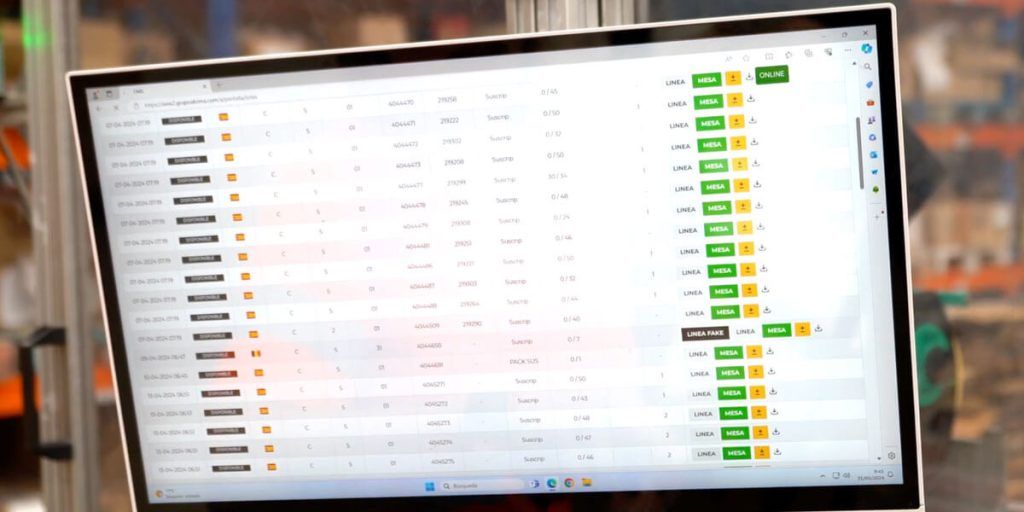
- Synchronise stock in real-time with the client's ERP and their online shop
- Manage e-commerce returns with the same diligence as a supplier return
- Scaling peaks without degrading service in the traditional channel
E-commerce Logistics in Vallès: Why Location Matters More Than You Think
- 24-hour delivery to any point on the Peninsula from warehouses in Barberà del Vallès or Martorelles
- Direct connection with international carriers with regular routes to France, Italy, Portugal and Northern Europe
- Access to the Port of Barcelona for Asian imports and exports outside the EU
- Competitive storage costs Regarding Barcelona's first crown, with the same connectivity
The 5 signs that your current logistics aren't ready for e-commerce
- Your shop's stock doesn't match the actual warehouse stock. If you have overselling, the problem lies in the integration with the operator's WMS.
- Online orders take over 24 hours to leave the warehouse. Every hour of delay is a potential bad review and a customer who won't return.
- Returns take longer than 48 hours to process. Until they are restocked, those units do not generate revenue.
- You have no visibility of the status of each order without calling the operator. If you need an email to know, you don't have real control.
- The operator did not manage the last volume spike well. If the last Black Friday generated massive incidents, it doesn't have the right structure.
One operator, two models, a single inventory
If you've got this far, you probably already know that the problem isn't logistics itself. It's that the model you have in place doesn't scale with the business you have today.
At Grupo Akoma we work with companies that manage B2B logistics and e-commerce at the same time, from our centers in the Vallès Occidental region. full-service logistics operator, One single inventory, real-time visibility for both channels.
If you'd like to know what your operation would look like with a system designed for both models, let's talk.
Frequently asked questions
Can a traditional logistics operator also manage my e-commerce?
It depends. A comprehensive logistics and distribution operator can manage e-commerce if they have invested in the right WMS, have API integrations with major online sales platforms, and their picking processes are designed for single-unit orders. The correct question isn't whether they can, but whether they have done it before and with what results. Ask for references from clients with an e-commerce model before you commit.
Which is more expensive: traditional logistics or e-commerce logistics?
The cost per unit in e-commerce is usually higher because each order requires individual picking, personalised packaging, and shipping management to the end consumer. However, well-executed e-commerce logistics reduce cancellations, improve repeat purchase rates, and eliminate the cost of manually managing incidents.
What is the difference between a 3PL provider and a full-service logistics provider?
A 3PL operator outsources physical logistics processes: warehousing, picking, transport. A comprehensive logistics operator adds value-added services: handling, co-packing, quality management, reverse logistics, and expiry date control. For companies with high-value products or in regulated sectors such as cosmetics or food, the difference is significant.
How many orders a month do I need for outsourcing to be profitable?
Most operators work with brands from 300-500 orders per month. Below this, the fixed integration cost may not be amortised. Above this, outsourcing is usually more efficient than managing your own warehouse and staff, especially with fluctuating volumes.