Changing your logistics provider is one of the most costly and risky processes in the supply chain. Not because of the complexity of the operation itself, but because of the impact that an incorrect choice can have: delayed orders, inventory with no visibility, customers lost.
Y sin embargo, muchas empresas eligen un operador logístico 3PL comparando solo precio y ubicación, dos variables que importan pero que, solas, no dicen nada sobre cómo va a funcionar la relación cuando aprieten los picos de demanda o cuando haya una incidencia real.
This article gives you eight criteria that an Operations Director or Supply Chain Manager should evaluate before signing. Not to make things more complicated, but to ensure the decision is sound.
Getting the wrong 3PL isn't noticeable in the first month – but it is afterwards.
The equation seems simple: you outsource to save fixed costs, gain flexibility and focus on your core business. But if you choose an operator that isn't prepared for your operation, savings turn into additional management costs, stockouts and a forced migration at the worst possible time.
The most common problems don't happen at the very beginning. They occur at the first unabsorbed peak in demand, during the first technical integration that takes weeks, or at the first inventory audit that doesn't balance. By then, you'll have been under contract for months.
The difference between a good logistics partner and one that complicates your life isn't in the sales pitch. It's in the actual operation.
Before diving into the criteria, a practical consideration: the best way to evaluate a 3PL is not to visit their facilities — it's to talk to their current customers, and specifically those who have an operation similar to yours.
The difference between declared capacity and available capacity
The capacity stated in square metres or pallet spaces does not equate to available capacity. Before choosing a 3PL logistics provider, it is necessary to check their current occupancy levels and whether they can handle peaks of 200–300% without compromising the service levels for other customers.
All operators describe their capacity in square metres, pallet positions or daily orders. These are useful figures, but they don't answer the question that really matters: how much of that capacity is free for your operation, today and in six months' time.
An operator with 73,000 m² spread across several sites has the structural capacity to support its clients’ growth. Another operator, which typically operates at 90% occupancy—even if its contract includes flexibility clauses—does not have that capacity in practical terms. A contractual commitment is no substitute for physical space.
Real scalability consists of three factors: storage capacity Available, in total; capacity to incorporate qualified personnel in short timescales without degrading the accuracy rate; and processes designed to absorb demand peaks without affecting the service level for other clients.
At Grupo Akoma, this scalability is built into our infrastructure. We are equipped to handle peaks of up to 300% on top of our baseline operations thanks to the distribution across 4 centros logísticos propios en Barcelona there are standardised processes that allow for scaling without compromising picking quality.
What to ask to understand real capability
The most useful questions to ask in a first meeting:
- What was your peak in orders last year, and how did you manage it?
- What is your current occupancy level, as a percentage?
- What is the timeframe for incorporating additional staff trained for our product type?
If the answer is generic ("it would depend on the situation") or doesn't include concrete figures, it's worth taking as a sign. It means they don't have a documented history of managing peaks – and the first time it's needed, you'll notice.
2. The difference between a proprietary WMS and a third-party one
A 3PL with its own WMS does not depend on third parties to adapt functionalities or resolve an integration. When the operator uses third-party software, every modification is subject to the external provider: deadlines, tickets, and priorities outside the control of the customer's supply chain.
In practice, the warehouse management system determines the level of control you will have over your inventory and the speed at which the operator can respond to your technical needs.
Un 3PL que trabaja con un proveedor de logística externos (3PL) se refiere a una empresa que externaliza sus operaciones de logística y gestión de la cadena de suministro a un tercero. Este tercero, el 3PL, se encarga de una o más funciones de la cadena de suministro, como almacenamiento, transporte, gestión de inventario, cumplimiento de pedidos y embalaje. Las empresas utilizan los 3PL para mejorar la eficiencia, reducir costes y centrarse en sus competencias principales. In-house WMS and OMS it doesn't depend on a third party to adapt functionalities, update processes, or resolve an integration issue. When you need a change, the point of contact is the operator. When the 3PL uses a third-party solution, every modification goes through the software provider: deadlines, tickets, priorities that no one in your chain controls.
The distinction is not technological – it is operational. The in-house WMS is not a marketing differentiator; it is the condition that enables the operator to adapt to your operation rather than forcing you to adapt your operation to their software.
Technical integration as a litmus test
The integration between your ERP and the operator's WMS is the most frequent bottleneck in the early months of a relationship with a 3PL. If it's not resolved from the outset, manual work becomes the default method — and inventory errors, consequently.
Before signing, it is advisable to request a diagram of the integration workflow: what APIs are available, in which direction the information flows, and within what timeframe the connection with the systems you use can be completed. A generic answer on this point is, in itself, sufficient information.
In Grupo Akoma, that autonomy is structural: each Integration project It is designed and maintained internally, without going through external providers for critical modifications.
3. Sector expertise as a risk filter
Experience in one sector does not automatically transfer to another. A 3PL operator must have established processes for the specific requirements of the client's category – batch management, expiry dates, regulatory certifications – before taking on the operation, not during it.
A logistics operator with years of experience in fast-moving consumer goods is not necessarily the most suitable for cosmetics, food with short expiry dates, or parapharmacy with regulated traceability. Accumulated experience in one sector does not automatically transfer to another.
Each category has its own operational requirements: batch and expiry date management, specific temperature and humidity conditions, product certifications such as ISO 22716 for cosmetics, or packaging and labelling regulations with regulatory consequences. An operator who has not previously managed these requirements will not know them – they will discover them in your operation.
Asking about sector experience isn't about seeking a watertight specialist. It’s about verifying that the operator has established processes for the specific risks of your category. A traceability error, whether in food or in *parafarmacia* (medicines sold outside of pharmacies, e.g., over-the-counter supplements and skincare), isn't just an operational problem – it can have regulatory and reputational consequences that go far beyond the isolated incident. Current transport and logistics regulations in Spain sets the reference frameworks for operations in these sectors.
The difference between an operator with real sector experience and one who merely claims it lies in the details: they can name two or three clients from the same sector, explain what specificities they manage for them, and show you how that process is documented. If the answer is generic, it's worth taking that as a red flag.
At Grupo Akoma, we work with very specific verticals — cosmetics, food, health and beauty, textiles — and each with differentiated operational processes according to the regulatory and logistical requirements of the sector.
4. Warehouse location and actual access to the transport network
The location of a 3PL warehouse is only relevant if it includes effective access to logistics infrastructure: national distribution hubs, corridors for export to Europe, and carrier networks with volume agreements. The postal address alone does not determine competitiveness in terms of delivery times or last-mile costs.
The warehouse location has a direct impact on distribution costs, delivery times and the ability to serve specific markets. But the postal address alone tells us nothing: what matters is effective access to logistics infrastructure.
For national distribution in Spain, proximity to major logistics hubs – Barcelona, Madrid, Valencia, Zaragoza – reduces last-mile times and costs. For export to Europe, the position on the Mediterranean axis and proximity to the Port of Barcelona are factors with a real impact on delivery times and transport rates.
It is not enough to ask where the warehouse is. It is worth evaluating what access it has to rail and port infrastructure, what network of carriers the operator works with, and whether it has volume agreements that result in more competitive conditions for its clients.
The Vallès-Barcelona axis for distribution in Spain and Europe
El Vallès Occidental, where the Barberà del Vallès town centre From Grupo Akoma, it is one of the main logistics hubs in Southern Europe. The direct connection to the Port of Barcelona Hub, access to national motorways and the concentration of transport operators in the area make this axis a strategic point for companies distributing to both the national and European markets.
5. The pricing model as an indicator of alignment of interests
A 3PL's pricing model reflects how its incentives are aligned with the client's. A quote that doesn't break down items – storage, handling, picking, extras – doesn't allow for an assessment of which costs will vary when volume or product mix changes.
A logistics provider's pricing model is not just a matter of cost. It reflects how their business is structured and the extent to which their incentives align with yours as your operation grows, changes, or experiences a seasonal peak.
The three most common models:
Flat rate or fixed fee Fixed monthly fee independent of volume. Predictable for budget planning, but can prove expensive with pronounced seasonality – you pay for capacity you don't use in the low season.
Variable tariff You pay based on stored units, orders processed, and services consumed. It's more suitable for operations with fluctuating volumes, but it makes cost forecasting months in advance more difficult.
Mixed model (fixed + random base): a minimum tariff that covers the base operation, plus variables reflecting actual volume. It is the most common model in medium and large B2B operations, and the one that best balances predictability and fairness throughout the year.
The relevant point isn't which of the three models is intrinsically better. It's that you understand what each line of the budget includes and which elements can vary significantly if your volume grows or your product mix changes. A budget without a breakdown is not a budget – it's an estimate. If you need to compare how a real proposal is structured, you can request it directly from Grupo Akoma.
| Warning sign | Positive sign |
|---|---|
| Budget without breakdown of items | Breakdown: Storage, Maintenance, Picking, Extras |
| No minimum documented fee | Explicit minimum conditions in contract |
| Penalties for opaque exit | Clear and reasonable exit clauses |
| No documented fee review | Annual review mechanism defined |
| Price well below market value | Competitive price with explained operation |
6. Certifications and traceability as a guarantee of the process
Logistics certifications — ISO 9001, ISO 22716 and sector-specific health registrations — are not a marketing differentiator; they are the guarantee that the operator has implemented third-party auditable processes. Without actual per-unit and batch traceability, a quality audit or a customer complaint becomes a manual investigation.
Certifications are not a bureaucratic requirement. In regulated sectors, they are the only guarantee that the operator has implemented auditable processes and that their operation complies with international standards verified by a third party.
The most relevant in B2B logistics:
- ISO 9001 — Quality management. The foundation for any operator working with medium and large enterprise clients.
- ISO 22716 — Good Manufacturing Practices for cosmetics. Essential if you operate in that sector.
- RSIPAC — Food health registration in Catalonia. Necessary if you manage food products.
- CEXGAN — Health export certificate. Relevant for international flows with regulated products.
Beyond certifications, real traceability implies a very specific capability: the operator can tell you at any time where each unit of your inventory is, which batch it belongs to, when it entered the warehouse, when it left, and to which order it was associated. Without this capability, a quality audit or a customer complaint becomes a manual investigation process — slow, costly, and prone to error.
At Grupo Akoma, we work with a certification framework which covers the main B2B requirements — ISO 9001, ISO 22716, RSIPAC, CEXGAN, and EcoVadis sustainability rating — across all logistics centres.
7. Real-time inventory visibility isn't an add-on
Operating without real-time access to outsourced inventory means relying on the reports that the 3PL decides to send, with the frequency and in the format that are convenient for them. Real-time visibility — stock on hand, orders in progress, service metrics — is the minimum requirement for planning and anticipating stockouts.
Operating without real-time visibility of inventory held by a third party isn't just an inconvenience. It's complete reliance on the reports that operator decides to send you – at the frequency they choose, in the format most convenient for them, and with the delay their internal processes dictate.
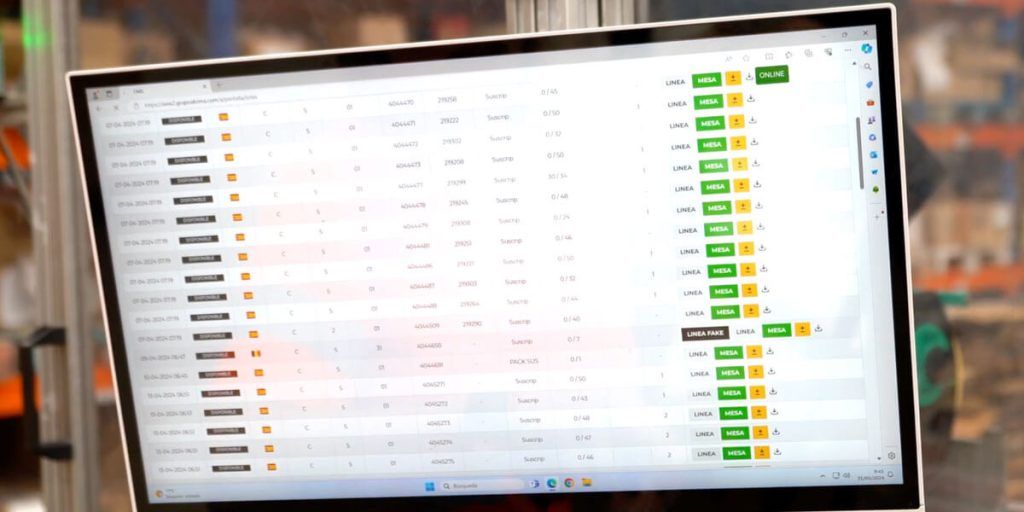
Real-time visibility means something else: access to a portal or API where you can check available stock, orders in progress, pending consolidations, and service metrics, without having to call anyone. That access has a direct impact on the ability to plan purchases, anticipate stock-outs, and detect deviations before they reach the end customer.
The difference between an operator that offers this visibility as standard and one that offers it as a premium service or not at all is not a price difference – it's a difference in relationship model. Without shared visibility, the relationship is provider-to-customer. With it, it can be that of an operational partner.
At Grupo Akoma Real-time inventory management is part of the standard service. It is not an additional module or a negotiable condition.
8. Customer references with similar operations
Asking a 3PL provider for references isn't just a formality: it's the only way to contrast what they claim with what their current clients experience. Only references from clients with a comparable sector, volume, and product type to the evaluator's are valid.
It is the simplest criterion to apply and the one most frequently omitted. Asking for references is not a formality: it is the only way to verify what the operator claims against what their current customers experience.
The key is in the specificity. Any reference won't do – you need clients with an operation similar to yours: similar sector, comparable volume, equivalent product type. An operator who manages standard fast-moving consumer goods well may face real difficulties with perishable food or high-turnover cosmetics. The valid reference is one that accurately verifies the scenario you are going to require of it.
An operator with that experience won't just give you names – they'll put you in touch with the operations or supply chain manager at that company. That willingness, or lack thereof, is information in itself.
The Akoma Group Operational History includes clients such as Liquats Vegetals, Cacaolat or Henkel — each with very different requirements. All are willing to speak to anyone who asks.
3PL or 4PL? The difference that matters before you choose
The terms 3PL and 4PL often appear in the same context, but they describe substantially different relationship models. Confusing them in an evaluation phase can lead to comparing non-comparable offers.
A 3PL operator carries out the physical and technological operation: storing, managing inventory, processing orders, and distributing. They have their own infrastructure and their own software. The relationship is direct between the company and the operator performing the service.
A 4PL, on the other hand, does not execute operations directly: it acts as an orchestrator that coordinates several 3PLs under a single management umbrella. Its value lies in global supply chain visibility and in managing multi-supplier complexity. It is a model that makes sense when a large company already works with five or six different 3PLs in various countries and needs someone to integrate and optimise them centrally.
For a medium-sized company outsourcing its logistics for the first time, or looking to consolidate its operations with a single provider, the natural model is 3PL. 4PL adds a layer of management and cost that is only justified when actual operational complexity demands it. Before that threshold, it is usually a more expensive solution for a problem that does not yet exist.
The three most frequent errors when choosing a logistics operator
Deciding solely on price without understanding the cost structure
The price of a 3PL is not a figure – it’s an architecture. A seemingly low fee can include large volume minimums, variable charges that scale exponentially during peak periods, or exit penalties that discourage switching providers. The mistake isn't in negotiating the price: it's in signing without understanding what each line item in the quote covers and under what conditions that figure changes. A quote without an explicit breakdown does not allow for rigorous comparison or reliable planning.
Skip the conversation with current customer references
A site visit is necessary but not sufficient. A well-organised warehouse and a competent sales team say nothing about how the operator handles an inventory issue at two in the morning, nor how they respond when there is a peak in 250% in November. That information is only available to someone who has experienced it first-hand. Omitting references — or settling for references that do not have a comparable operation — removes the only independent verification mechanism available before signing.
Do not validate the actual capacity before signing
The gap between the capacity stated in the commercial proposal and the capacity actually available can be significant. An operator that typically operates at 85–90% capacity has no real scope to absorb peaks, even if the contract includes scalability clauses. Verifying the current occupancy level, staffing structure and the track record of how they have managed previous peaks is not mistrust — it is due diligence before committing the supply chain for 12 or 24 months.
When it's time to talk to operators
If you're in the process of evaluating a change of logistics operator and want to compare your situation with real operational criteria, tell us what you need. An initial conversation serves both parties to know if it makes sense to move forward before investing time in a proposal.
Speak with the Grupo Akoma team
How to evaluate a 3PL if you're in the early stages of the process
If you are still exploring options and have not yet made contact with any providers, the logical order is:
- Define your operational requirements before speaking to anyone: SKU volume, approximate cubic metres, type of picking, current systems, seasonality.
- Use this list of criteria as an initial filter to discard operators that do not meet the minimums.
- Request a visit to the actual premises – not the showroom or the meeting room.
- Speak with at least two current customer references from the operator.
That's the logic with which We worked on the first conversations in Grupo Akoma — requirements first, visits after, and always contact with clients who have gone through the same thing.
Frequently asked questions
How long does it take to change logistics providers?
It depends on the complexity of the operation, but generally speaking, you should allow between six and twelve weeks from contract signing to stable operation in the new warehouse. This timeframe includes the transfer of inventory, technical integration between systems, training of the operator's team on the client's specific requirements, and a parallel run-in period where it's verified that the processes are working correctly before ceasing activity with the previous operator. Attempting to force this timeframe to be shorter is the most common cause of problems during the transition.
What happens to my stock during the transition?
Stock must be moved from one warehouse to another in a controlled manner with validated inventory at both ends. The usual practice is to perform a full physical inventory at the origin warehouse before the transfer, to start from a reliable figure. During the transfer, stock in transit is recorded and is not available for orders – it is a period that must be planned in advance to avoid stock-outs. A good operator will have a documented transition protocol that covers exactly this scenario and explains it clearly before signing.
What's the minimum commitment a 3PL typically asks for?
Most logistics operators work with contracts of at least 12 to 24 months in duration, with annual rate reviews. For more complex operations or those requiring investment in client-specific infrastructure (such as special temperature-controlled facilities or copacking lines), terms may be longer. The important thing is not the term itself – it's that early exit conditions are clearly documented, with detailed notice periods and economic conditions specified. Be wary of contracts that do not include exit scenarios.