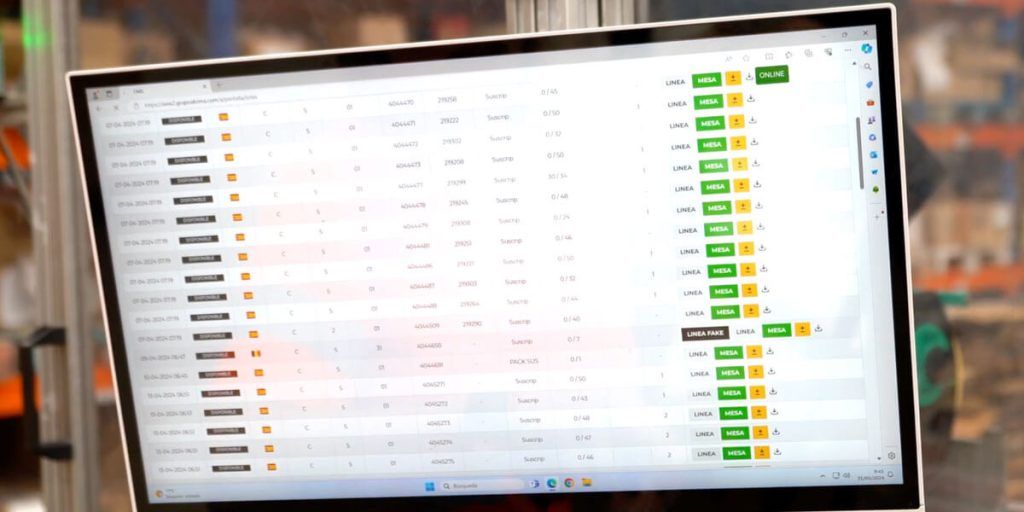
What is OTIF and why it matters in your supply chain
The OTIF (On-Time In-Full) measures the percentage of orders delivered on time and complete according to the customer's requirements. It is not enough to deliver within the set timeframe. If even a single line item is missing or the quantity is incorrect, the metric fails.
For an operations manager, this KPI is the true thermometer of the service. A low OTIF results in stockouts at the destination, financial penalties and administrative overcosts due to incident management.
How to calculate the OTIF indicator
The mathematical formula is straightforward. The number of orders delivered on time and complete is divided by the total number of orders processed, multiplied by 100.
For an order to meet the OTIF condition, it must simultaneously pass three filters:
- On time delivery takes place within the time window agreed with the customer or the logistics operator.
- In-Full: All requested units are delivered, with no shortages or discontinued or incorrect references.
- Correct documentation: Delivery notes, labels and fiscal data must match the purchase order exactly.
If you work with regulated sectors, such as cosmetic logistics Hello parapharmacy logistics, an OTIF failure usually results in the complete rejection of the goods at the unloading dock.
Main causes of a low OTIF
Identifying the source of the problem prevents applying ineffective solutions. Process failures usually concentrate on three critical points:
1. Order-picking errors
Issues due to wrong items or incorrect quantities ruin the In-Full metric. A lack of automation and sloppy inventories are the usual triggers in traditional warehouses.
2. Transport deviations
Collection delays, saturation of last-mile routes or traffic incidents directly affect the On-Time component of the KPI.
3. Outdated data in the ERP
If the theoretical stock does not match the physical stock available on the premises, orders that cannot be fulfilled in full are confirmed.
Practical strategies for improving OTIF
Improving this metric requires auditing internal processes and demanding rigor throughout the entire chain. To find out how to optimise your goods management, you can check our our centres logistical.
Apply these operational measures to raise your success rate:
- Cyclical inventory audits: reduce the divergence between the system and physical stock to avoid confirming unviable orders.
- Dock and dispatch control: speed up lorry loading to avoid departures outside the allocated time window.
- System integration: connect your ERP with the warehouse management system (WMS) for real-time visibility. If you outsource, choose one Integrated storage and logistics services that gives you access to that data.
Furthermore, having standardised processes under quality regulations is essential. You can consult our guide on ISO 22716 Complete Guide to understand the standards applied in stringent industrial environments.
Grupo Akoma · Logistics operator
Does your OTIF drop during demand peaks?
We prepare more than 50,000 order lines a day with 99.9% picking accuracy, from 4 own centres in Barcelona. We work with companies from 100 pallets or 1,000 shipments per month.
Frequently asked questions
What is considered a good OTIF percentage?
An industry benchmark stands at over 95%. However, highly demanding sectors require ratios in excess of 98% to avoid penalties.
What is the difference between OTIF and OTD?
OTD (On-Time Delivery) only measures whether the order arrived at the agreed time, ignoring whether it was complete or had missing items. OTIF is a much more demanding and realistic metric.
How a poor OTIF affects logistics costs
It causes high hidden costs: merchandise returns, unplanned urgent transport, overtime in order fulfilment, and potential loss of B2B customers.
How often should this KPI be measured?
Ideally, daily monitoring should be carried out to detect operational issues immediately, with monthly closures and trend analysis.