There's a difference that few companies detect in time: the one that separates a logistics operator capable of managing current volume from one capable of managing next year's volume, or that of the three weeks of Black Friday.
Most serious logistical problems don't happen under normal circumstances. They happen when volumes surge, when you launch a campaign that goes better than expected, when you open up a new market, or when seasonality hits harder than the previous year. That's when the operator that "worked fine" stops doing so.
This article focuses specifically on what it really means to have the capacity to move large volumes, how an operator not designed for scaling degrades, and what questions to ask before signing a contract. If you are looking for a more general selection guide, you can start with our Guide to choosing a 3PL logistics operator.
What does having the capacity to move volume really mean
When a company is looking for a logistics operator for large volumes, the conversation usually starts with warehouse square metres. It's the most visible figure and the easiest to compare. It's also the least relevant for understanding if the operator can absorb a peak in activity without the operation breaking down.
The actual capacity for moving volume has four components that do not appear in any sales brochure.
Declared picking capacity under peak conditions. The number of lines the operator can prepare per day must be measured at the worst time of the year, not the best. An operator who processes 10,000 lines daily during normal periods may not have the system or staff to multiply that by three or five during a campaign. This figure must be requested in concrete numbers and verified against references from real operations.
Documented and standardised processes. When volume spikes and the team is bolstered with temporary staff, what ensures the operation runs just as smoothly is not the individual experience of each operator, but the fact that the process is documented. Without that foundation, team growth introduces variability, and variability in logistics translates into errors.
Real-time management system. At high volumes, a stock update arriving hours late generates unfulfillable delivery promises, crossed orders, and rapidly accumulating incident costs. Real-time inventory isn't an advanced feature; it's the bare minimum requirement for operating at volume.
A scalable operator with a rapid onboarding model. The operator who can absorb a peak is not the one with the most permanent staff. It's the one with accelerated training protocols and agreements with temporary employment agencies that allow for onboarding in days, not weeks, without degrading the quality of the operation.
A large warehouse with manual processes, a slow management system, and no staff scaling model is, operationally, smaller than it appears.
How does a system that isn't designed for peak loads degrade?
The problem of an operator who is too close doesn't manifest as a sudden collapse. It manifests as a gradual degradation that starts with deadlines, continues with accuracy, and eventually affects the relationship with the end customer.
The first sign is an increase in order preparation times. An operator who, under normal conditions, prepares an order in 24 hours begins to need 36 or 48 hours when the volume increases by 40%. This is not because the processes are failing, but because the picking system is not designed for that pace, the warehouse routes are not optimised for that flow, and staff cannot cope without structured reinforcement.
The second symptom is an increase in errors. The error rate in order fulfilment rises when the pace of work exceeds the capacity of the control system. A well-designed operator has automated checkpoints that work just as fast with 1,000 lines as with 5,000. One that relies on manual checking loses accuracy when volume presses on timescales.
The third symptom is a loss of visibility over stock levels. When the system does not update stock levels in real time, discrepancies between recorded and physical stock levels multiply. This results in two simultaneous problems: you sell items you do not have in stock, and you fail to sell items you do have because the system does not show them as available.
The fourth symptom is reactive communication. If the operator lacks real-time visibility, they cannot flag up a problem before the customer notices it. And when volumes are high, this reactive approach to incident management places a disproportionate strain on resources on both sides.
What makes it particularly difficult to spot this pattern before it becomes a problem is that it happens gradually. Each spike is slightly worse than the last, but never serious enough to prompt a decision to make a change.
Until it is.
Signs that your current provider isn’t keeping pace with you
You don’t need to wait for a crisis to find out whether your provider has scalability limitations that will become a problem. There are early warning signs that indicate your operational structure isn’t ready to keep pace with your company’s growth.
Preparation times increase as the volume increases. Scaling up should keep lead times the same, not increase them. If lead times consistently increase during busy periods, the operator has no real operational flexibility.
You don’t have real-time stock visibility from your own dashboard. If you need to call an operator, send an email or wait for a weekly report just to find out how many units you have available, the management system isn’t designed for the volume and speed your operation requires.
The error rate is rising in campaigns and peaks. If claims for incorrect orders are concentrated in periods of high activity, then the verification process is not robust when the pace is high. Operator accuracy depends on the conditions, not the system.
No one has asked you about your 12-month volume forecast. If, during the onboarding process or in regular reviews, no one has asked how many lines you expect to handle next year or what campaigns you have planned, the operator is reacting to volume rather than anticipating it.
The contract does not specify peak capacity. A well-designed service level agreement (SLA) should include capacity commitments for peak periods, not just under normal conditions. If the contract only specifies lead times for the usual volume, there is no guarantee as to what will happen when that volume doubles.
Incident reporting is reactive. If you only find out about a problem because a customer has contacted you, rather than because an operator has alerted you, the operation lacks the visibility needed to manage peaks effectively.
High-volume logistics operator versus standard operator
| Criterion | Standard operator | Operator with high-volume capacity |
|---|---|---|
| Declared picking capacity | Expressed in square metres or stock locations | Expressed in lines per day based on actual peak data |
| Staff scaling during peak periods | No structured model | Agreements with Temporary Employment Agencies and documented accelerated training |
| Inventory management system | Batch updates or partially manual updates | In real time, accessible from the client panel |
| Precision during peak demand periods | It degrades when the pace quickens | Maintained by standardised processes and automated verification |
| Capacity planning | Restore to current volume | Forecasting: plan with 3-12 month forecasts |
| Customer visibility | Periodic or on-demand reports | Real-time dashboard with orders, stock, and incidents data |
| Peak SLA | No specific commitment | Contractually established for periods of high activity |
| Verifiable volume references | Non-existent or not provided | Real customers with contrasting volumes |
What to ask a 3PL to see if they can absorb your future volume
The questions that answer whether a carrier can scale with you are not the usual ones in a logistics tender. They are operational and quantitative questions that a well-sized carrier answers with concrete data. One that isn't, answers with generalities.
How many lines do you process per day at your documented peak?
The answer must be a verifiable number with a real reference. The documented maximum peak of an operator is the best indicator of their real capability. If they don't have that data or cannot associate it with a real client, they have no experience managing large volumes.
How do you plan staffing levels for a peak that exceeds a customer’s usual volume by 200%?
The answer should describe a model, not an intention. Do you have formalised agreements with temporary employment agencies? In how many days can you onboard additional operational staff? How long does that staff need to become fully proficient with the client's processes?
What is your order picking accuracy rate during peak periods?
The standard for operators designed to handle high volumes is around 99.91%. The key question is whether this figure applies to peak periods or only to normal conditions. If the operator does not distinguish between the two situations, it is likely that it is not measuring accuracy with sufficient granularity.
What happens to real-time inventory when volume triples?
A well-designed management system works just as quickly with 1,000 orders as it does with 10,000, because the update is automatic and does not depend on manual intervention. If the response involves any batch update process, visibility will degrade at the moment you need it most.
Can you show us the management dashboard our team would have access to?
The visibility that an operator offers a customer cannot be adequately described with words. Asking them to demonstrate this in a concrete demo, with real customer data or in a test environment, is the most direct way to assess whether the available information is sufficient to manage a volume operation.
How is the SLA defined for periods of high demand in your current contracts?
An SLA that only covers normal conditions offers no guarantee when it matters most. A contractual commitment for peak capacity is the clearest signal that the operator has confidence in their infrastructure for those moments.
Which client with a similar profile to ours can we contact as a reference?
A real customer, with a comparable volume and seasonality profile, who can speak about how the operator performed during the last peak demand, is worth more than any sales presentation.
How do we do it at Grupo Akoma?
At Grupo Akoma, the ability to process large volumes forms the bedrock of our operations. We currently process up to 50,000 lines per day with an accuracy rate of 99.91%. These figures are based on actual operations, including periods of high activity.
What allows for maintaining that precision at that volume are three elements working together: fully documented and standardised processes, real-time inventory, and a staffing model that allows for reinforcing the team within days.
Process standardisation means that when we onboard temporary staff during a peak, the operation does not degrade. The procedures are designed so that someone joining the team can execute the process correctly from day one, without relying on the personal judgment of an experienced operator. That's what ensures the accuracy rate is maintained when the pace picks up.
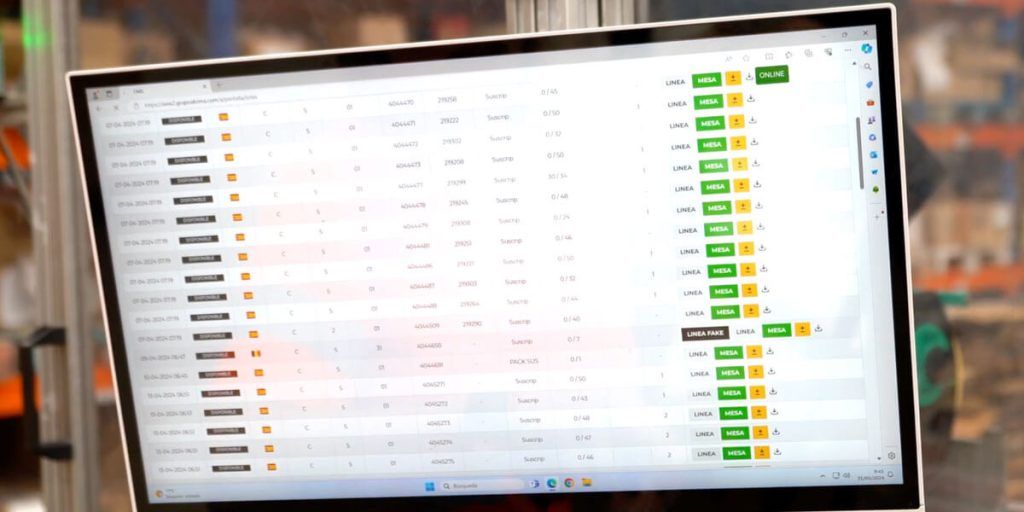
The real-time inventory management system gives the customer full visibility over available stock, orders being prepared, and the operational status at any time, from their own dashboard. These are not reports that arrive at the end of the day. It is information updated at the moment each movement occurs, allowing business decisions to be made based on real data.
Capacity planning is part of the service from the outset. We work with each client to anticipate their peak periods: campaigns, launches, seasonality. This planning allows us to prepare the operational structure in advance, so that when the volume arrives the system is already ready.
The result for the customer is that they can grow without having to wonder if the logistics can keep up with that growth.
For accounts with specific volume needs, we begin with an initial analysis phase where we size the operation according to the real forecast, not just the current volume, and establish the corresponding SLAs, including peak capacity commitments.
If you are assessing whether your current operator can accommodate your planned growth, or if you are looking for an operator for an operation that already handles significant volume, you can find out the complete operational details on our Integrated storage and logistics page to see how ours are structured Real-time technology and inventory.
Speak with the Akoma Group team
If your operation experiences demand peaks that your current operator doesn't manage well, or if you are growing and need to know if your current logistics structure can keep up with that growth, the Akoma team can analyse your current situation and show you how the operation works in practice.
No compromises. A conversation with real data about your volume and your peaks.
Preguntas frecuentes
How many lines can a logistics operator handle per day for large volumes?
There is no single threshold that defines «high volumes», as this depends on the sector, the type of product and the complexity of order fulfilment. What matters is not the absolute number of lines, but whether the operator can maintain lead times and accuracy when their usual volume doubles or triples. An operator claiming a capacity of 50,000 lines per day with 99.91% accuracy at peak activity has a very different profile to one describing its capacity in terms of square metres of warehouse space.
What is the order picking accuracy rate and why does it matter?
The accuracy rate measures the percentage of orders picked without errors (correct items, correct quantities, correct destination) out of the total number of orders processed. In high-volume operations, even a seemingly low error rate has a significant financial impact. A rate of 99.1% out of 10,000 daily orders equates to 100 incidents per day: management costs, returns, and a negative customer experience. An operator designed for high volumes maintains its accuracy rate during peak periods, not just under normal conditions.
How is logistics planned for demand peaks like Black Friday?
Planning for a peak in demand requires anticipation on three fronts: personnel (agreements with temporary work agencies, accelerated training, shift structures), sufficient stock in the warehouse in advance of the campaign, and a management system capable of updating inventory in real-time when the flow of orders is intense. A well-dimensioned operator begins planning for Black Friday in September at the latest, not in November.
What is the difference between a standard 3PL and a provider designed for large volumes?
The main difference lies in the operation's design, not its size. An operator designed for large volumes has documented processes that remain stable with fluctuating staff, a real-time management system that doesn't lose speed with volume, and a capacity scaling model that allows for absorbing peaks without degrading accuracy or deadlines. A standard operator may have the same physical facilities and lack any of those elements.
Can I change my logistics provider if mine isn't scaling with my company?
Yes, and it's more common than you might think. Most changes occur because the original operator worked fine when volumes were lower and hasn't been able to scale with the company's growth. The process has a design phase for the new operation, a stock migration phase, and a go-live phase planned to minimise disruption. With an operator experienced in onboarding large accounts, the switch can be structured with no impact on the final customer service.
Before speaking with a logistics operator for large volumes, you need to have the following data clear:
**1. Product Information:**
* **Nature of the goods:** What are you shipping? (e.g., electronics, food, chemicals, machinery, apparel).
* **Dimensions and weight:** Average and maximum dimensions (length, width, height) and weight per unit or per pallet.
* **Packaging:** How are the goods packed? (e.g., boxes, pallets, crates, loose).
* **Hazardous materials:** Are any of the goods hazardous? If so, what classification and specific handling requirements?
* **Perishability/Fragility:** Are the goods perishable, fragile, or temperature-sensitive?
* **Value of goods:** Understand the approximate value for insurance and security purposes.
**2. Volume and Frequency:**
* **Estimated monthly/weekly volume:** How much are you shipping on a regular basis? (e.g., number of units, number of pallets, number of shipments).
* **Peak season volume:** Do you have periods of significantly higher volume? If so, what are they and by how much do they increase?
* **Shipping frequency:** How often do you expect to ship? (e.g., daily, weekly, bi-weekly).
**3. Origin and Destination:**
* **Origin points:** Where will the goods be shipped from? (Specific addresses, postcodes, warehouse locations).
* **Destination points:** Where do the goods need to go? (Specific addresses, postcodes, customer locations, retail stores, distribution centres).
* **Geographic coverage:** What regions/countries do you need to cover?
**4. Service Requirements:**
* **Type of transport:** What modes of transport are you looking for? (e.g., road freight, sea freight, air freight, rail).
* **Transit time expectations:** What are your required delivery times? (e.g., same-day, next-day, standard, expedited).
* **Warehousing needs:** Do you require storage, cross-docking, or other warehousing services? If so, what are the expected inventory levels and turnover?
* **Value-added services:** Are there any additional services you need? (e.g., kitting, labelling, returns management, customs clearance, freight forwarding, freight consolidation).
* **Delivery requirements:** Are there specific delivery needs at the destination? (e.g., appointment delivery, liftgate service, inside delivery).
**5. Budget and Expectations:**
* **Budgetary range:** What is your approximate budget for these logistics services?
* **Key performance indicators (KPIs):** What metrics are most important to you for success? (e.g., on-time delivery rate, damage rate, cost per unit).
* **Current logistics challenges:** What problems are you trying to solve with a new logistics partner?
**6. Business and Contact Information:**
* **Company name and nature of business.**
* **Contact person details:** Name, role, email, phone number.
* **Are you a manufacturer, distributor, retailer, etc.?** This helps them understand your role in the supply chain.
Having this information readily available will allow you to have a much more productive conversation with potential logistics operators, enabling them to provide accurate quotes and tailored solutions for your specific needs.
The most relevant data for correctly sizing the operation are the average volume of lines or orders per day under normal conditions, the volume at the highest peak in the last 12 months, the forecast of growth over 12 months, the number of active SKUs and their turnover, seasonality and planned campaigns, and whether the operation is B2B, B2C or both. With that information, an operator can provide a proposal scaled to reality, not a generic scenario.
Is there an additional cost for real-time inventory?
It depends on the operator. In a well-designed operation, real-time inventory is part of the base management system, not an additional module or a separate cost. It is how the operator manages their own operation, and the visibility it gives to the customer is a natural consequence of that system. If an operator presents real-time inventory as a premium service, it is worth understanding what system they use under standard conditions and what information remains available to the customer.