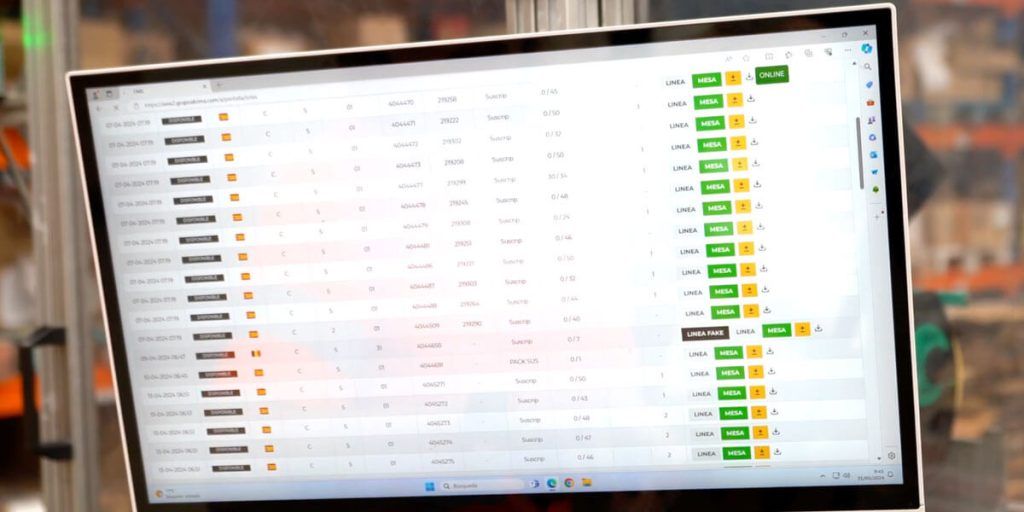
The growth of omni-channel commerce and complex B2B operations have made manual stock synchronization workflows obsolete. When a company manages multiple sales channels—marketplaces, B2B portals, online stores, and traditional retail—coordinating inventory availability with warehouses becomes a critical bottleneck. Errors in order routing skyrocket stockouts and reduce the final customer service level.
An Order Management System (OMS) (Order Management System) acts as the distributing brain of the connected supply chain. It centralizes orders originating from any channel, analyzes real-time inventory across all nodes in the network, and determines the optimal fulfillment route before transferring the order to the executing warehouse. Without this digital intelligence layer, brands suffer from stock mismatches and delivery penalties.
In this article, we analyze the technical architecture of an OMS, its operational differences compared to the ERP and the warehouse management system (WMS), the advantages of its integration with a logistics operator, and the steps to implement this technology without interrupting the daily activity of your supply chain.
What is an OMS order management system in logistics?
An OMS order management system is a software platform designed to manage the complete lifecycle of a commercial order, from the moment of purchase to its delivery to the customer and eventual returns management. Its primary purpose is to unify the visibility of orders and inventory into a single centralized interface, eliminating data silos generated by independent sales channels.
Unlike conventional transactional modules, the OMS is not limited to recording that a customer has made a purchase. It evaluates critical logistical variables such as the location of available inventory, transportation costs, committed delivery times, and the operational capacity of each node to automatically decide from where each product unit should be prepared and shipped.
This orchestration capability is essential when evolving from ecommerce logistics versus traditional logistics, as it allows coordinating shared inventories for wholesale sales and high-turnover unit orders without duplicating safety stock or generating unforeseen stockouts.
Differences between ERP, OMS, and WMS: who does what?
One of the most common mistakes in supply chain technological planning is confusing the responsibilities of each software. Although they share inventory and order data, the ERP, OMS, and WMS fulfill totally differentiated functions in daily operations.
The ERP: financial and accounting core
The ERP (Enterprise Resource Planning) is the company's accounting, financial, and procurement system of record. It manages invoicing, standard costs, raw material purchasing, and business margins. However, traditional ERPs are not optimized to process thousands of inventory transactions per minute or to execute dynamic real-time order routing algorithms.
The OMS: channel and order orchestrator
The OMS operates as the intermediate layer between sales platforms and distribution centers. Its specialty is global visibility of committed and Available-To-Promise ( Available-To-Promise) inventory. It makes routing decisions based on business rules: geographical proximity, freight cost, contracted service level, or stock availability by batch.
The WMS: physical execution inside the warehouse
The WMS (Warehouse Management System) comes into action once the OMS has assigned the order to a specific physical center. It governs internal operations within four walls: the location map, order picking routes, barcode scanning, packaging, and shipping by loading dock.
| Criterion | ERP | OMS | WMS / WMS |
|---|---|---|---|
| Main focus | Finance, purchasing and global accounting | Multichannel order orchestration and routing | Physical operations and warehouse movements |
| Stock visibility | Accounting balance and aggregated stock | Available stock per channel and in transit | Exact physical location by aisle and level |
| Response time | Batch or deferred processing | Real-time via APIs and webhooks | Real-time on radio frequency terminals |
| Transport management | Transportation cost recording | Service and carrier selection by rules | Generation of shipping labels and manifests |
| Business rules | Credit limits and invoicing | Order prioritization and shipment splitting | Picking route optimization and consolidation |
Critical functionalities of an OMS order management system
Implementing a modern OMS is not just about channeling orders, but about equipping the supply chain with advanced automatisms that avoid manual intervention in routine processes. Below, we review the core functions that any operations manager should demand.
1. Distributed Order Management (DOM)
The DOM engine (Distributed Order Management) is the algorithmic heart of the OMS. It applies configurable rules to split or consolidate shipments based on efficiency criteria: if a cart contains three references and one of them is only available at a secondary distribution center, the software decides whether it is more cost-effective to fragment the delivery or transfer the item to consolidate it at origin.
2. Real-time availability calculation (Available to Promise)
When a buyer adds a product to the cart in a marketplace or places a B2B order in a closed portal, the OMS provisionally deducts that unit. This prevents accidental overselling while the order goes through payment validation or creditworthiness filters. The information is immediately communicated to all connected channels to update catalogs in seconds.
3. Expiration control, batch tracking, and regulatory traceability
For sectors with high technical demands such as cosmetics, parapharmacy, or food, the OMS must comply with strict shipping guidelines. By integrating the warehouse FIFO method with batch and best-before date control, the system blocks orders if the remaining shelf life does not meet the service level agreements (SLAs) established with each commercial client.
4. Comprehensive returns management (RMA)
Reverse logistics penalizes commercial margins if not managed in a structured way. An OMS manages return authorizations (RMA), issues automatic return labels for the carrier, and as soon as the warehouse receives and inspects the material, it updates available inventory and issues the refund or replacement order without friction.
Operational flow: the journey of an order through the OMS
Understanding how the OMS interacts with the rest of the technological infrastructure allows for designing clean and fault-tolerant integrations. The standard processing cycle follows a rigorous sequence:
- Order capture: The transaction is generated in the sales channel (corporate client ERP, Shopify/Magento store, or EDI) and enters the OMS via webhook or REST API call.
- Normalization and validation: The software validates delivery data, normalizes postal addresses, checks payment status, and verifies if the customer has specific packaging requirements.
- Inventory allocation: The DOM algorithm queries unencumbered stock in each warehouse and reserves the corresponding units.
- Transmission to WMS: The OMS generates the picking/packing order in the assigned logistics warehouse system to begin physical handling tasks.
- Confirmation and tracking: After packaging, the WMS returns the package number, selected batch, and carrier tracking number to the OMS. The OMS updates the sales platform and notifies the end customer.
- Closure and invoicing: The shipment is communicated to the ERP to trigger invoice issuance and adjust the accounting inventory balance.
Direct impact of the OMS on the OTIF index
A logistics provider's performance is measured by the accuracy of its deliveries. The reigning metric in supply chain audits is the OTIF (On Time In Full), an indicator that evaluates the percentage of orders delivered on time and with the exact agreed quantities.
The use of an OMS order management system drastically reduces the two main causes of OTIF failure: delays due to inefficient warehouse allocation and stockouts caused by synchronization mismatches. By automating order release according to the cut-off time windows (cut-off times) of each carrier, picking teams receive mathematically prioritized work, eliminating end-of-shift bottlenecks.
Criteria for choosing and integrating an OMS into your operations
Not all companies require the same level of technological sophistication. When evaluating tools in the market, it is advisable to analyze the following technical variables before signing a license:
- API-First Architecture: The system must offer well-documented public APIs to connect new sales channels or carriers without relying on costly custom developments.
- Real multi-warehouse support: It must manage own warehouses, 3PL logistics operator depots, and transshipment points without mixing restricted inventories.
- Handling complex B2B rules: Capacity to apply personalized price lists, scheduled orders, and specific delivery conditions per commercial account.
- Scalability during demand peaks: Performance guarantee during intense commercial events where order entry per minute multiplies tenfold without generating latency.
For companies in highly regulated technical sectors such as logística de parafarmacia or cosmetics, it is essential that the OMS guarantees compatibility with lot numbers and digital quarantine control.
The advantage of connecting your OMS with a 3PL logistics operator
Having excellent orchestration software is useless if the physical infrastructure that executes the orders lacks precision and agility. When an Order Management System (OMS) is natively synchronized with the systems of an experienced logistics operator, the supply chain reaches its maximum efficiency.
From our specialized facilities, such as the Barberà del Vallès logistics center, we integrate our clients' information flows with our WMS to guarantee total visibility of stock movements, strict compliance with dispatch deadlines, and complete lot traceability. This technological synergy allows brands to scale their business volume without assuming fixed costs for complex software or oversized infrastructure.
Frequently asked questions
What is the basic difference between an OMS and a WMS?
The OMS decides from which warehouse or node an order should be prepared and shipped based on global stock and costs, while the WMS governs physical execution within the facilities: rack location, picking routes, and dispatch at the loading docks.
At what point does my company need to implement an OMS?
It is recommended when you sell through two or more simultaneous channels, have multiple storage points (or combine your own warehouse with a 3PL), and suffer from frequent stock mismatches or involuntary overselling that damages your service level.
Can an ERP completely replace an OMS order management system?
In low-turnover operations with few channels, an ERP may be sufficient. However, in dynamic environments with multiple points of sale, the ERP lacks the real-time update speed and distributed routing algorithms that characterize a modern OMS.
How does an OMS impact returns management?
The OMS automates the creation of return merchandise authorizations (RMA), coordinates collection with transport agencies, and updates commercial inventory as soon as the warehouse validates the status of the returned product, speeding up the refund to the customer.
If you are looking to optimize the integration of your order systems with a rigorous and scalable warehousing operation, get in touch with our logistics team to design a solution tailored to your business.