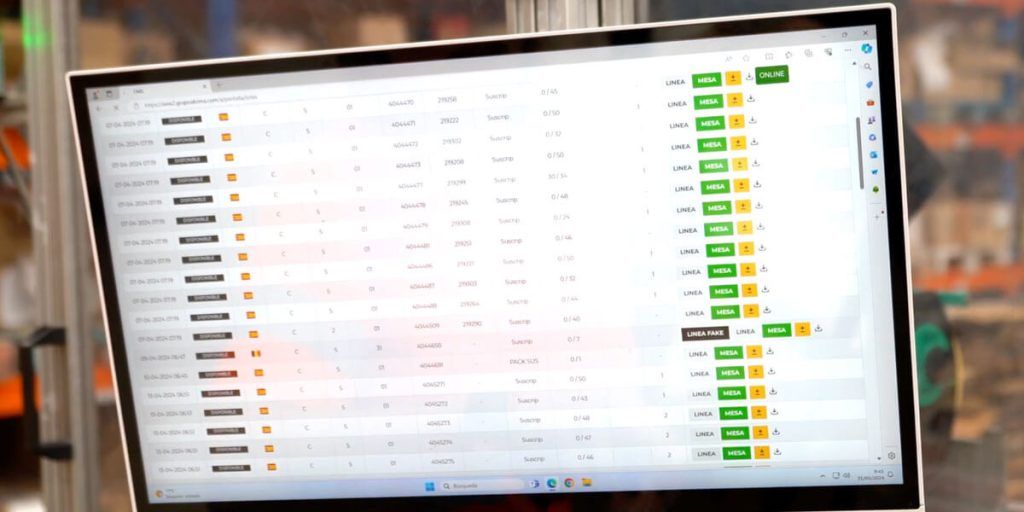
No one starts a business thinking about returns, but there comes a point where they become the most time-consuming, margin-destroying, and chaotic part of the operation.
The problem isn't returns. The problem is not having a system to manage them.
And when we say system, we're not talking about a web form or a 30-day policy. We're talking about a clear operational process within the warehouse: who receives the product, how it's sorted, where it's located, when it's available again, and what happens if it can't be resold.
Without that, every return is a small crisis. Multiplied by hundreds a month, it's a structural problem.
Daily life without a defined returns process
When there isn't a clear protocol, this is what happens in the real operation:
- Returned products arrive at the warehouse and accumulate in a corner. Nobody knows exactly what's there or since when.
- The warehouse team leaves returns for when they have time. But that time never comes because daily picking is always more urgent.
- Some products are returned to stock without inspection. Others remain out of the system for weeks.
- The system inventory does not match the physical inventory. You are selling units that are damaged or holding onto stock you could be selling.
- Customer service has no visibility over the return status and cannot provide answers to the buyer.
- The operations manager spends hours putting out fires instead of improving processes.
This is not a hypothetical scenario. It is the reality for many companies that have grown faster than their operational capacity. And the more volume, the worse it becomes.
The 5 hidden costs of not having a returns system
The most dangerous aspect of poor returns management is that the impact doesn't appear as a single line on the P&L. It's spread across small leaks which, when added together, represent a significant portion of the margin.
1. Direct processing cost
Every manually managed return consumes warehouse, customer service, and administrative time. When the process is not systematised, a single return can require more than 14 minutes of management among all parties involved. With an automated and clear process, this time drops to just over 2 minutes.
Multiply that difference by hundreds of returns a month and you'll see where some of your operational capacity is going.
Phantom stock and inventory breakages
Without a controlled re-entry into the system, returned products are left in limbo. They are not available for sale, but they are also not registered as damaged or withdrawn.
The result: your system shows stock that doesn't reflect reality. You might be selling units that don't exist in a saleable condition, or blocking units that could be generating revenue. In either case, you're losing money.
3. Product depreciation
A returned product that remains unclassified and unreconditioned for weeks loses value. In categories like fashion, electronics, or food, time is of the essence. What can be resold at 100% today%may require a discount in two weeks, or may become irrecoverable.
A clear returns system classifies the product on the same day it arrives: resalable, refurbishable, or discard. This protects the margin.
4. Opportunity cost of equipment
When your warehouse team spends part of their day dealing with returns that don't follow a process, they're not doing what they should be: preparing orders, optimising locations, improving picking times.
And when the customer service team doesn't have real-time information on the status of each return, they become an intermediary sending internal emails and chasing responses. That time has a direct and an indirect cost: the inability to scale without hiring more people.
5. Loss of customers who do not return
Returns are the most sensitive moment in the customer relationship. If the process is slow, opaque or confusing, that customer won't come back. And they won't complain: they'll simply shop elsewhere.
An agile and professional returns process can turn a bad shopping experience into a good brand experience. But for that, you need a system, not improvisation.
The domino effect, from returns to the rest of the operation
The lack of control over returns doesn't remain isolated. It contaminates the rest of the chain.
Stock discrepancy → The sales team launches campaigns on unreliable stock → Orders are generated that cannot be fulfilled → Cancellations and claims → More burden on customer service → Less time to manage own returns.
It's a self-reinforcing circle. And the bigger the company gets, the faster it spins.
When operations depend on people who "already know how it works" rather than a documented and repeatable process, any absence, surge in demand, or team change can break the entire system.
Checklist ¿Su operación tiene un problema con las devoluciones?
Review how many of these situations you recognise in your company:
- Returned products take longer than 48 hours to be classified.
- You don't have a specific area in the warehouse for returns
- The system inventory does not match the physical inventory more than once a month
- Customer service cannot check the status of a return in real-time
- You don't know the average cost of processing a return.
- Returned products are restocked without a standardised quality control check.
- You have detected damaged units that were sold as new.
- When there are spikes in returns (post-campaign, post-Christmas), operations get blocked.
- You depend on one or two people to manage the entire returns process
- You have no data on the return rate by product, reason, or customer
If you've ticked 3 or more, it's not an isolated issue. It's a systemic problem.
What changes when returns management is professionalised
It's not about returns disappearing. It's about them ceasing to be a problem and becoming another process within your operation, as controlled as picking or shipping.
A professional returns management system involves:
- Dedicated area in the warehouse. Returns have their own physical space, their own assigned team, and their own workflow, separate from the rest of operations.
- Immediate classification. Each returned product is inspected, sorted (resellable, refurbishable, scrap) and logged in the system on the same day.
- Automatic re-entry to stock. Usable units are available for sale again without manual intervention or delays.
- Full traceability. From the moment the customer requests a return until the product is back in stock, every step is recorded and viewable.
- Data to decide. Return rate by product, by reason, by channel. Information that allows you to act on the cause, not just the consequence.
When it works like this, returns stop being an emergency and become useful information for improving the business.
Why do many companies solve this by outsourcing
Setting up a system like this internally requires space, technology, trained staff, and processes. For many companies, especially those that are growing, it doesn't pay to develop that infrastructure on their own.
Outsourcing returns management to a logistics provider that already has a system in place allows for:
- Remove the operational problem from day one
- To have real-time inventory visibility, including returns
- Scaling without every peak in returns causing a crisis
- Free up the internal team to focus on selling, not managing incidents
- Convert an unpredictable and variable cost into a controlled and measurable process
Not all companies need to outsource all their logistics. But when the pain point is returns management, an experienced operator with their own system can solve what might take months to build in-house.
Your operation needs a system, not more effort
If you've come this far, you probably already know the problem isn't your equipment. It's that there's no system in place to support what your business needs today.
More people, more hours and more effort don't fix a process problem. They temporarily compensate, but they don't resolve it.
At Grupo Akoma, we work with companies that come to us with this exact diagnosis: an operation that was working until it stopped working. We help them set up a returns management system integrated into their entire logistics operation, with real-time inventory, full traceability, and the ability to scale seamlessly.
If you want to know what your operation would look like with a clear returns system, let's talk. We can do a quick audit of your current situation and show you what would change.