Short answer: retail textile logistics is not about sending parcels to consumers, but about supplying stores, franchises, department stores and wholesalers at the pace of each season. From a textile logistics operator, require control by size, colour and SKU, separate areas for folded and hanging garments, picking by cartons and pallets with the labels each customer asks for, fast replenishment to the point of sale and a clear flow for end-of-season returns.
Transparency: this article is published by Grupo Akoma. Third-party data comes from their official websites and is linked under “Sources”.
How is retail textile logistics different from ecommerce?
In the online channel, each order is one or two garments for a consumer. In physical retail and wholesale, the order is a carton or pallet with dozens of SKUs, sizes and colours for a store, a chain's distribution platform or a distributor. The picking unit, paperwork, transport and calendar all change.
Fashion works in seasons and launches. Three moments shape the operation:
- Initial collection: rolling out the season to the entire store network in a few days. It is the largest outbound volume and allows no delays.
- Replenishment: smaller, more frequent orders to cover the sizes that sell out first.
- Sales, drops and end of season: outbound peaks, transfers between stores and, afterwards, a wave of returns of unsold stock.
If your brand mainly sells online to end consumers, within the group this is covered by Bolian with its ecommerce fulfilment service for fashion and textile brands. Here we are talking about stores, franchises and trade customers, the scope of our textile logistics for brands, retail and store replenishment.
How is replenishment to own stores and franchises organised?
Replenishment is where sales are won or lost: if a store runs out of size M of its best-selling garment, the customer walks away. What must work:
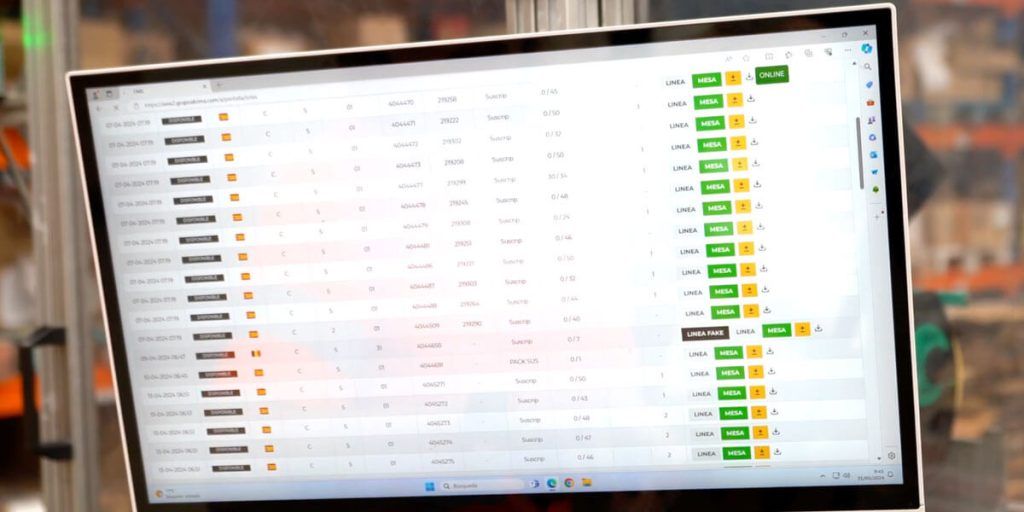
- Inventory by size, colour and SKU from receipt. If a garment is recorded incorrectly on arrival, the error carries through. Verification on receipt is the first check.
- Picking per store with validation of every unit, by full cartons or by individual sizes.
- Cut-off times and fixed routes, so the store knows on which day and in which time slot the goods will arrive.
- Own stores and franchises handled separately. Own stores usually receive automatic replenishment; franchises place their own orders on different terms. The system must handle both flows without mixing stock.
- Shipment traceability for fashion retail: each package is tracked to the store with its delivery note.
At Akoma we record each garment by size, colour and SKU from the first movement, validate the attributes during picking and track every shipment in real time, as we explain on our page on transport coordination and delivery routes.
What do department stores and chains require from a fashion brand?
Selling to a department store or a multi-brand chain means accepting its supplier manual, and the operator has to apply it order by order. The usual requirements are:
- Delivery appointments. The platform assigns a day, time and dock; arriving late can mean the unloading is refused.
- Customer labelling. Price or reference tags on every garment and logistics labels on every carton and pallet; the GS1-128 label with an SSCC code identifies each package and links it to the delivery note.
- Advance shipping notice: many customers ask for the delivery note via EDI before the lorry arrives.
- Packaging and palletising rules: pallet height, weight per carton, mixed or single-SKU cartons and garment format. Non-compliance usually ends in chargebacks or returns.
Ask the operator to show you how it sets up a new customer's requirements. At Akoma we prepare full-carton and pallet orders for B2B customers, with pallet strapping and labelling and adaptation to each channel's delivery requirements, as detailed on our page on carton and pallet order picking for B2B customers. EDI and each department store's specific labels are validated at start-up, customer by customer.
When does cross-docking fit in fashion distribution?
Cross-docking means receiving goods and dispatching them with almost no storage. We have already explained the concept, its types and its requirements in our article on what cross docking is and how it works in the warehouse, so here we focus on what is specific to fashion.
Cross-docking for fashion distribution makes sense when the collection arrives from the manufacturer already allocated by store and only needs consolidating by route, or when a department store requests a closed order that arrives ready-prepared. It fits less well with daily replenishment, which depends on actual sales and needs stock to pick sizes from.
Ask the operator whether it receives advance notice of what each lorry is carrying, how it checks cartons without opening them and what happens if the manufacturer is late. If it does not set this out in writing, make it a contract requirement.
Folded or hanging garments: what should the warehouse offer?
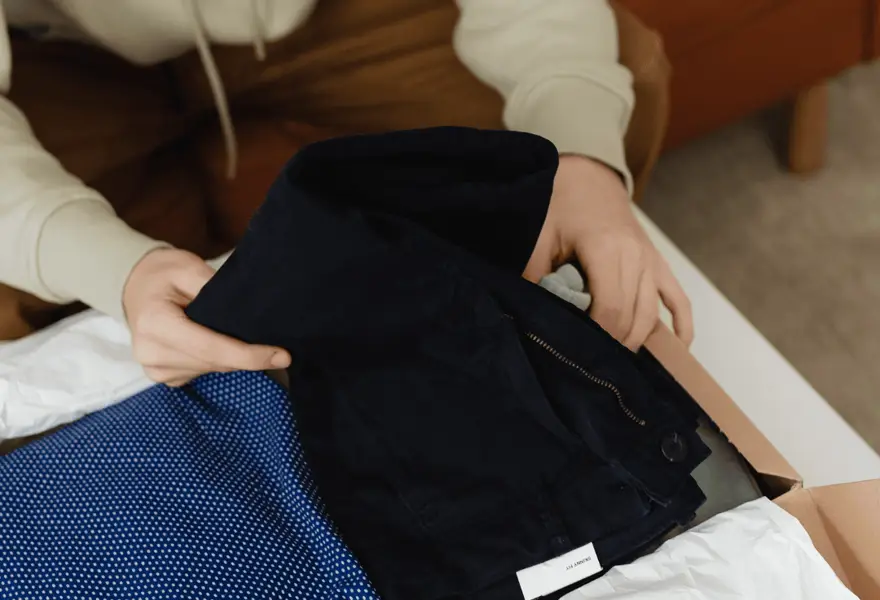
Specialist storage for textile products starts with the format. Folded garments go in cartons or on shelves and take up little space. Hanging garments (coats, blazers, dresses) need hangers or hanging systems and take up more space, but arrive at the store ready for the shop floor.
The advantages of hanging garment transport for retail: garments do not crease, the store does not have to iron or hang them and the product goes on sale sooner. In return, it needs equipped vehicles and more space. Many brands combine formats: hanging for delicate garments, folded for basics and knitwear.
At Akoma we have specific areas and separate processes for folded garments, hanging garments and accessories. What you should confirm with any operator is how it handles the transport and distribution of hanging garments to the store: whether it has its own hanging equipment or works with specialist carriers, and how garments are protected in transit.
How are end-of-season returns, outlet stock and peaks handled?
When the season closes, stores return what has not sold, with tags, security tags and sometimes minor defects. If nobody sorts it quickly, the stock is tied up just when it is needed for the outlet. A good flow has four steps:
- Sorting by condition: perfect, minor defect or unfit for sale.
- Reconditioning where appropriate: ironing, relabelling, removing stickers.
- Reintegration into available stock or allocation to the outlet, as the brand decides.
- Data for product and quality teams: return reasons, the sizes returned most and manufacturing defects.
This is how we handle fashion returns at Akoma; if you want to go deeper into process design, see our guide on how to set up a returns system in the logistics operation.
Peaks are the other test: the initial collection, sales or Black Friday multiply outbound volumes in a few days. Ask how it sizes its teams, how far in advance it needs the forecast and what lead times it guarantees at peak.
Which textile logistics operators serve the retail channel in Spain?
We only include what each company publishes on its official website. Akoma comes first because it publishes the article; the order of the rest is not a ranking.
1. Grupo Akoma
B2B logistics operator since 1991, with 73,000 m² across four own centres in Barcelona: Lliçà d’Amunt, Barberà del Vallès, Caldes de Montbui and Martorelles. It holds ISO 9001 certification and has 99.9% accuracy. In textiles it publishes control by size, colour and SKU, areas for folded and hanging garments, store replenishment and delivery, B2B picking by cartons and pallets, and returns with reconditioning. It works from 100 pallets or 1,000 shipments a month. Its website does not mention the use of RFID or its own hanging garment transport.
Best fit if… you are a brand with stores, franchises or wholesale customers and want an operator close to Barcelona that combines storage, B2B picking and returns. More detail on our fashion and textile logistics page.
2. Logisfashion
Founded in Spain in 1996, specialising in fashion. According to its website, it has more than 250,000 m² in seven centres in Spain (provinces of Guadalajara, Toledo, Barcelona and Girona) and a presence in Mexico, Panama, Colombia, Uruguay and Asia. On its retail logistics page it lists distribution to own stores, large retailers, multi-brand stores and wholesalers; storage of folded and hanging garments; RFID and sorters; initial collections, replenishment and returns; hanger-packing and ironing; and a customs warehouse. It publishes ISO 9001 and ISO 27001 and cites customers such as Castañer and Bobux.
Best fit if… your brand has international distribution, imports from Asia and is looking for a single operator for origin, customs and warehousing.
3. Logwin
International logistics group. Its subsidiary Logwin Solutions Spain is headquartered in Sant Feliu de Llobregat (Barcelona) with an office in San Fernando de Henares (Madrid), according to its locations page. In warehousing it publishes sector-specific solutions, with fashion among the examples, and cross-docking. Its Spanish-language website does not detail specific services for hanging garments or store replenishment.
Best fit if… you need to combine warehousing in Spain with air and sea freight within the same group.
4. ID Logistics
Contract logistics group with 42,000 employees, according to its website. On its sectors page it describes, for fashion, import and export flows, customs, replenishment of SKUs stored horizontally or vertically, and adaptation to sales periods. It cites a European multi-brand fashion leader whose stores it supplies from a mechanised platform. That page does not detail its centres in Spain.
Best fit if… you are a high-volume chain looking for a dedicated centre or a turnkey project.
5. Amphora Logistics
Operator with an office in Barcelona that advertises 3PL services in Spain, Italy, France and the United States. Its fashion page presents itself as “100% specialised in ecommerce”, with RFID counts. On its B2B fulfilment page it lists specific labelling, EDI and each recipient's protocols, with orders by carton or pallet. It cites brands such as Ölend.
Best fit if… you are an ecommerce-born brand that is starting to sell to distributors and multi-brand stores.
| Operator | Location in Spain | Retail channels published | Hanging garments | Technology published |
|---|---|---|---|---|
| Grupo Akoma | Lliçà d’Amunt, Barberà del Vallès, Caldes de Montbui, Martorelles | Stores and points of sale, B2B by cartons and pallets | Specific areas for folded and hanging garments | WMS with control by size, colour and SKU and ERP integration |
| Logisfashion | Guadalajara, Toledo, Barcelona, Girona | Own stores, large retailers, multi-brand, wholesalers | Storage of folded and hanging garments, hanger-packing | Proprietary WMS, RFID, sorters, AutoStore robotics |
| Logwin | Sant Feliu de Llobregat, San Fernando de Henares | Not detailed on its Spanish-language website | Not detailed on its Spanish-language website | WMS, pick-by-light, automated warehouses |
| ID Logistics | Not detailed on its sectors page | Supplying chain stores | Replenishment of SKUs stored horizontally or vertically | Mechanised platforms, collaborative robots |
| Amphora Logistics | Barcelona (office) | Distributors and trade customers | Not detailed on its website | Proprietary RFID, EDI, OMS and WMS |
For a broader view, see our comparison of logistics operators in Barcelona.
What should you ask for before signing with a textile logistics operator?
- A demonstration of variant control: how it records size, colour and SKU on receipt and how it validates each unit during picking.
- A test with a real wholesale order with the labels, palletising and paperwork of one of your customers.
- Appointment procedure with department stores: who books them and what happens if they are missed.
- EDI capability to send shipping notices and delivery notes in the format your customers require.
- A solution for hanging garments in the warehouse and in transport, with own or subcontracted resources, in writing.
- Initial collection and sales plan: the forecast it needs, extra staffing and guaranteed lead times at peak.
- End-of-season returns flow: sorting criteria, lead times for reintegration into stock, and reports.
- Traceability per package to the store and access for your team to stock and shipments in real time.
- KPIs and regular review: inventory accuracy, orders delivered complete and on time, and incidents by channel.
To see how we apply it, take a look at our retail textile logistics operation in Barcelona or get to know the network of Grupo Akoma warehouses as a logistics operator in Barcelona.
Grupo Akoma · Since 1991
Do you distribute fashion to stores, franchises or department stores?
Storage for folded and hanging garments, control by size, colour and SKU, store replenishment and B2B picking by cartons and pallets from Barcelona. Tell us about your operation and we will prepare a proposal.
Frequently asked questions
What is retail textile logistics?
It is the management of storage, picking and distribution of clothing and accessories to own stores, franchises, department stores and wholesalers. It differs from ecommerce in that orders are cartons or pallets with many sizes and colours, with a seasonal calendar and requirements specific to each customer.
What is the difference between the initial collection and replenishment?
The initial collection is the rollout of the whole season to the store network in a few days. Replenishment consists of smaller, more frequent orders to cover the sizes and colours that sell out first.
What are the advantages of hanging garment transport for retail?
Garments arrive crease-free and ready for the shop floor, the store does not have to iron or hang them and the product goes on sale sooner. In return, it needs equipped vehicles and takes up more space in the lorry.
What labelling do department stores require?
It depends on each customer, but it usually includes price or reference tags on the garment and a logistics label on every carton and pallet, normally GS1-128 with an SSCC code, linked to the delivery note sent via EDI.
Is cross-docking suitable for replenishing fashion stores?
It works mainly when goods arrive from the manufacturer already allocated by store and only need consolidating by route. For daily replenishment, which depends on actual sales, stock is usually needed in the warehouse.
What happens to end-of-season returns?
They are sorted by condition, garments that allow it are reconditioned by ironing or relabelling, and they are returned to available stock or sent to the outlet, as the brand decides.
What minimum volume does Grupo Akoma require?
Grupo Akoma works from 100 pallets or 1,000 shipments a month. If your brand mainly sells online to end consumers, the group covers this with Bolian Logistics.
Sources
- Grupo Akoma: textile logistics
- Grupo Akoma: picking and order preparation
- Grupo Akoma: about us (centres and certifications)
- GS1 Spain: what the SSCC code is
- Logisfashion: retail logistics
- Logisfashion: centres in Spain
- Logwin: locations
- Logwin: warehousing
- ID Logistics: business sectors
- ID Logistics: corporate website
- Amphora Logistics: fashion logistics
- Amphora Logistics: B2B fulfilment
Information taken from each company's public website as of November 2026. Third-party data is cited as published by each company and may have changed; check their website for current information.